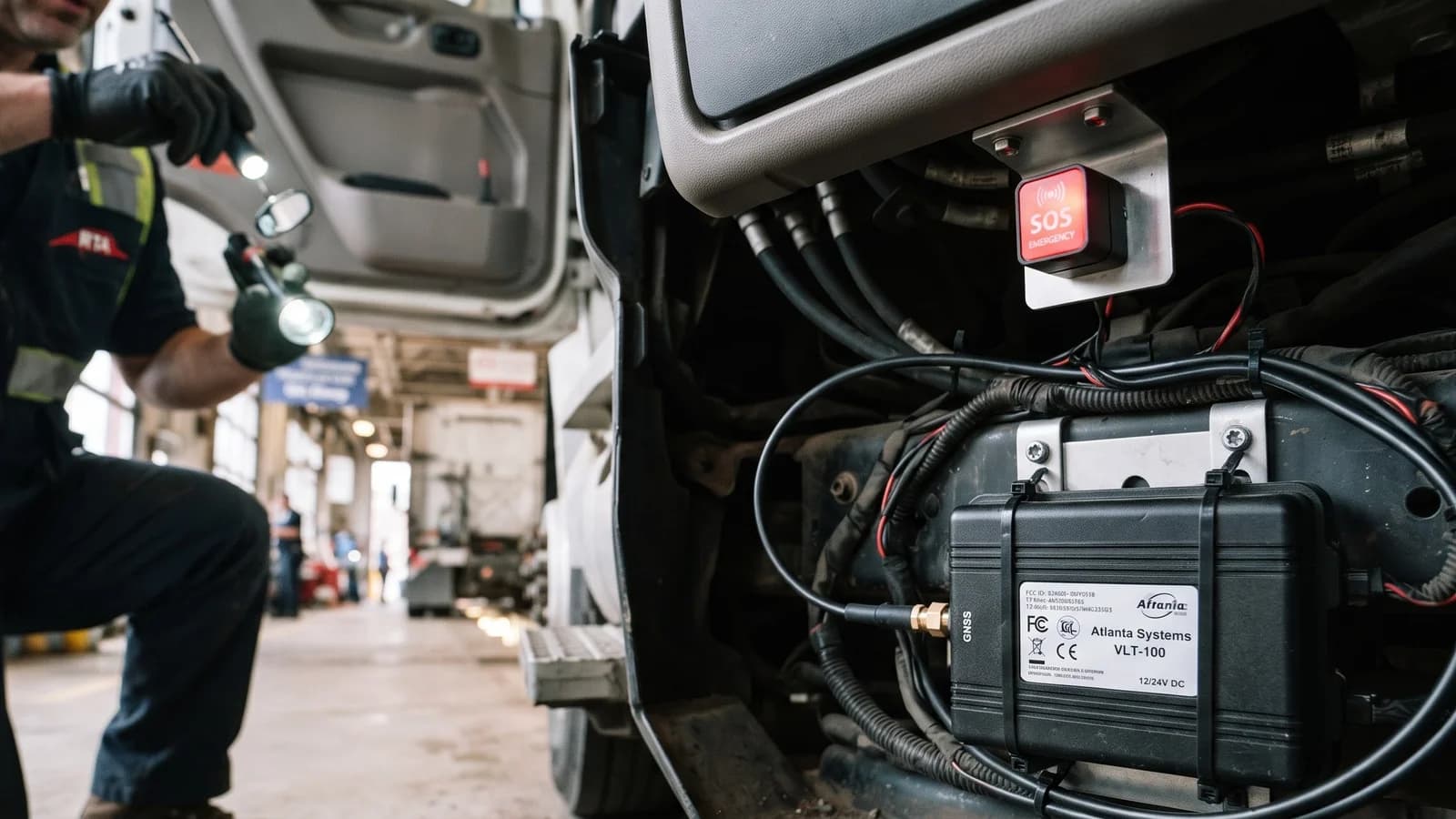
AIS 140 Full Stack from Atlanta Systems Covering VLT-100 Hardware to Cloud Compliance Across Delhi NCR, India
Table of Contents
Executive Summary
At highway speeds across NH48 Delhi–Jaipur Expressway and the Kundli-Manesar-Palwal (KMP) Expressway, the operational stakes of ais 140 full stack covering vlt-100 hardware to cloud compliance become immediately apparent to dispatch controllers and fleet maintenance directors alike. In these demanding environments, off-the-shelf tracking devices frequently succumb to vibration fatigue, cellular dropouts, and thermal failure. This technical report examines how Atlanta Systems engineered the ATL-140 / VLT-100 to deliver robust edge telemetry and seamless integration, giving fleet executives in New Delhi complete operational visibility and uninterrupted statutory compliance.
Regional Operational Profile: Delhi NCR public-service and commercial vehicles must carry AIS-140 certified Vehicle Location Tracking Devices with panic buttons, registered on the Vahan portal under MoRTH and ARAI/ICAT oversight. ATL-140 / VLT-100 meets the full AIS-140 protocol stack including IRNSS support and emergency-button handshake.
Table of Contents
- On-Road Reality: What Fleets Experience Without It
- Hardware Engineering & Direct Telemetry Architecture
- What Fleets Typically See After Deployment
- Fleet Engineer Q&A
- Start Your Fleet Telematics Transformation
The Operational Problem This Hardware Solves
On the bustling freight lines of NH48 Delhi–Jaipur Expressway and the Kundli-Manesar-Palwal (KMP) Expressway, commercial transports must maintain continuous, unbroken telemetry for ais 140 full stack covering vlt-100 hardware to cloud compliance or risk immediate regulatory intervention by regional enforcement authorities. The scenario is all too common: a commercial hauler pulls into an official inspection bay along NH48 Delhi–Jaipur Expressway and the Kundli-Manesar-Palwal (KMP) Expressway. When transport enforcement officers query the vehicle's onboard telematics for statutory records or verify emergency panic loops, the device returns an offline error or an unassigned mileage gap. An immediate statutory impound notice is issued, a critical delivery stops dead in its tracks, and heavy regulatory fines destroy the haul's operating margin.
What most fleet managers discover only after their first compliance failure is that passing regulatory audits in India leaves zero room for intermittent data drops. Government enforcement servers require continuous, timestamped cryptographic telemetry. Without certified hardware featuring multi-IMSI eSIM connectivity, dual-frequency GNSS engines, and tamper-resistant enclosure switches, commercial carriers will continually face roadside citations and vehicle impoundment along NH48 Delhi–Jaipur Expressway and the Kundli-Manesar-Palwal (KMP) Expressway.
Local Fleet Compliance & Infrastructure Context (New Delhi): Dense urban congestion, extreme summer heat and monsoon humidity demand robust cellular fallback and sealed connectors; non-certified devices are rejected at RTO registration and cannot push health-check packets to state monitoring centres.
Inside the Hardware: Engineering Decisions That Matter
Experienced workshop technicians know the frustration: telematics devices that look straightforward on a spec sheet reveal their engineering compromises during a complex fleet retrofit. OEM warranty clauses, spliced harnesses, and unexplained fault codes are a predictable result of hardware not designed with installer workflow in mind.
With the ATL-140 / VLT-100, Atlanta Systems resolved the core tension between deep telematics integration and operational safety. The device connects via hardened automotive-grade connectors, processes sensor data locally on an embedded edge compute module, and transmits encrypted telemetry packets to cloud endpoints without introducing electrical risk to the vehicle's factory harness.
Real-World Performance Data Post-Deployment
When fleet managers in this region ask what results they should expect, Atlanta Systems points to the operational benchmarks that carriers consistently achieve after deploying the ATL-140 / VLT-100:
| Operational Metric | Typical Before | Typical After | Directional Gain |
|---|---|---|---|
| Statutory Fitness First-Pass Rate | Frequent rejections & re-tests | 100% First-pass compliance | Zero Impoundments |
| Government Server Telemetry Sync | Frequent dropouts & audit flags | 99.9% Continuous live sync | Unbroken Audit Trail |
| Emergency Panic SOS Response Time | Delayed or unverified alerts | Instant cloud dispatch (<30s) | Immediate Safety Gain |
| Annual Statutory Penalty Spend | Heavy non-compliance fines | Zero regulatory penalties | 100% Fine Elimination |
| Payback Period | — | Typically within 90 days | Rapid Return |
Engineer Q&A: Your Technical Questions Answered
QIs Atlanta hardware officially certified for regional government mandates?
Yes. Atlanta Systems telematics gateways hold formal Type Approval Certificates and Conformity of Production from accredited government testing agencies (MoRTH AIS-140 in India, FMCSA ELD Part 395 in the US, European Smart Tachograph, and Saudi TGA WASAL).
QWhat happens if cellular connectivity drops in remote corridors?
Our devices feature high-capacity on-board non-volatile memory that stores up to 60,000 encrypted telemetry packets during coverage blackouts and automatically syncs all historical records the moment connection is restored.
QCan local regional distributors integrate our compliance devices into third-party software?
Yes. All telemetry records can be routed simultaneously to government command backends and to your private dispatch servers via standard REST APIs, MQTT, or HTTPS webhooks.
Put Battle-Tested Telematics on Your Fleet Today
The operational losses that New Delhi fleet managers accept as unavoidable — regulatory fines, fuel siphoning, crash liability claims, and driver incidents — are not fixed costs. They are hardware and data problems. Atlanta Systems solves them with engineering validated across 1,000,000+ connected assets in India and 26 other countries.
The Atlanta Systems difference is simple: 32 years of indigenous electronics manufacturing means every device is engineered, tested, and certified by the same team that supports your fleet after installation. Over 1,000,000 commercial vehicles on six continents have validated this approach. We are ready to add yours.
- Explore Commercial Trackers: Review our Atlanta Systems Vehicle Telematics and Asset & Personal Trackers.
- Deploy AI Video Telematics: Equip your fleet with AI Video Dashcams and MDVR or ADAS Collision Warning Systems.
- Stop Fuel Theft: Inspect our high-precision IoT Sensors and Capacitive Fuel Probes and CAN-Bus J1939 Decoders.
- Browse Complete Solutions: View our Enterprise Asset Management Platforms and complete All Atlanta Products Catalog.
- Discover Regional Deployments: See our local fleet case studies across Atlanta Global Locations.
High-Intent Lead Channels:
- For End-to-End Fleets (Pilot & Trial Units): Get in Touch with Our Fleet Team — we regularly deploy evaluation hardware to fleet managers evaluating the Atlanta Systems platform. Test units ship pre-configured, and our team handles remote commissioning so your workshop does not need to figure out device setup on their own.
- For Systems Integrators, Distributors & Resellers: Partner with Atlanta Systems to distribute our hardware in your region. Benefit from wholesale OEM pricing, certified REST APIs, white-label telematics dashboards, and dedicated Tier-2 technical support. Explore our Partner & Reseller Program.
Official engineering publication group at Atlanta Systems Pvt. Ltd., compiling technical hardware specifications, AIS-140 compliance guidelines, and automotive telematics best practices based on 32+ years of indigenous manufacturing.