End-to-End 4G LTE-M Gateways from Atlanta Systems for Continuous Coverage Across Dubai's E11 Sheikh Zayed Road
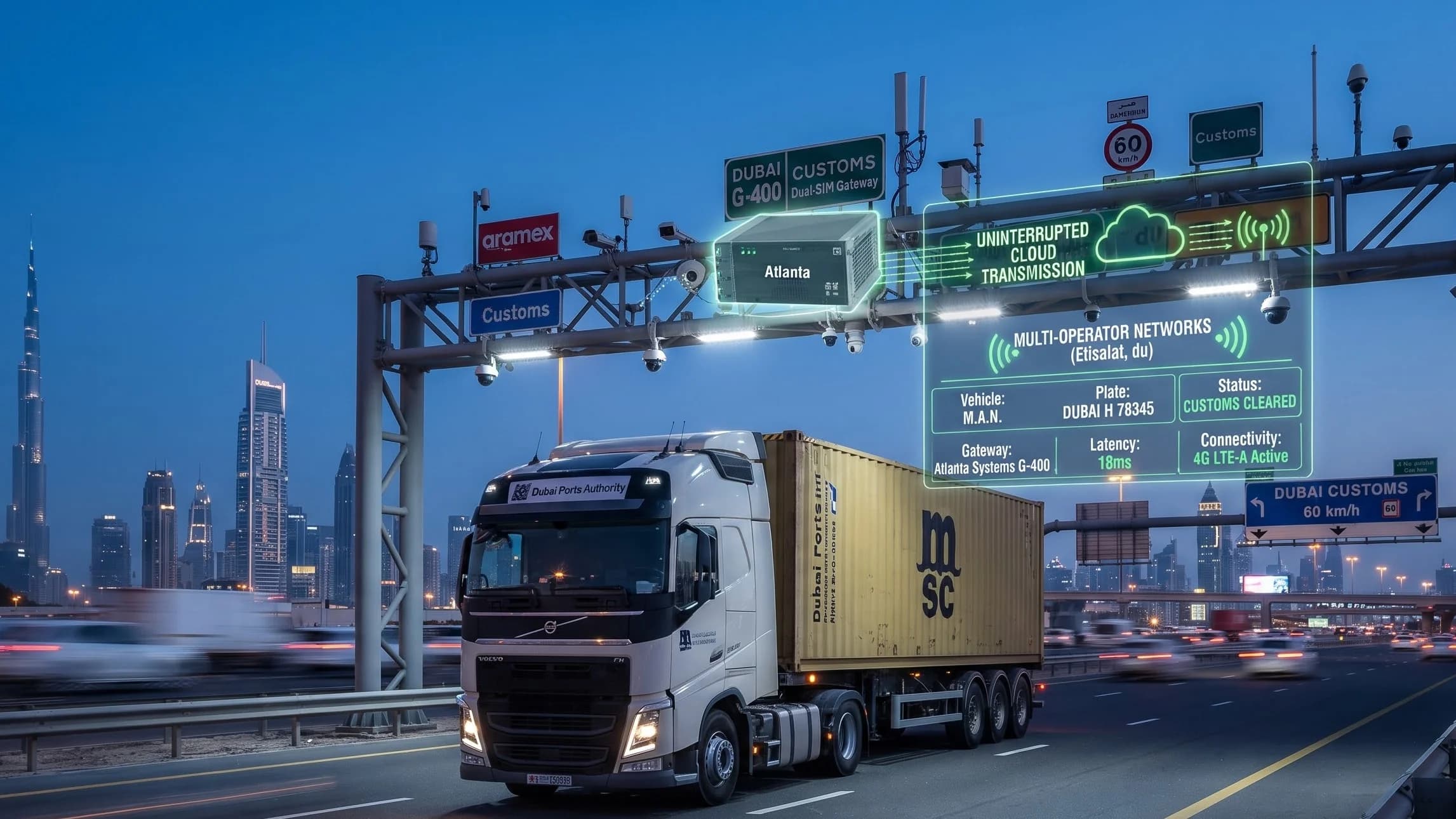
Table of Contents
Operating commercial vehicle fleets across the United Arab Emirates presents telematics hardware with a uniquely challenging environment. High-speed multi-lane transit along the E11 Sheikh Zayed Road and E311 Emirates Road demands sub-second telematics responsiveness, while intensive container operations at Jebel Ali Port require seamless gateway bridging between vehicle CAN bus diagnostics and cloud warehouse management systems. Compounding these demands are ambient summer temperatures exceeding 50°C, direct sunlight causing dashboard temperatures up to 85°C, and rigorous regulatory requirements mandated by Dubai's Roads and Transport Authority (RTA) and the Security Industry Regulatory Agency (SIRA). To maintain reliable connectivity and real-time sensor ingestion under these severe operating conditions, fleet enterprises rely on Atlanta Systems' GWC-100 Industrial IoT Telematics Gateway.
Logistics Landscape: Navigating Dubai's Freight Arteries
Dubai serves as the primary transshipment hub for the Gulf Cooperation Council (GCC). Thousands of heavy tractor-trailers, refrigerated distribution trucks, and bonded container haulers traverse the 558-kilometer E11 artery connecting Abu Dhabi, Dubai, and the Northern Emirates daily. In this fast-paced corridor, telematics dropouts result in dispatch delays, missed delivery time-slots, and potential regulatory fines from transport authorities.
```
```
Telemetry hardware deployed in the UAE must satisfy three uncompromising requirements:
- Ultra-Low Latency Cellular Communication: 4G LTE Cat-M1 / Cat-1 connectivity capable of maintaining live telemetry during 120 km/h highway speeds without packet loss.
- Dual-SIM / eSIM Multi-Carrier Failover: Instant, autonomous switching between Etisalat (e&) and du to eliminate blind spots near border checkpoints and industrial port yards.
- Severe Heat Resistance: Industrial components certified to operate continuously without thermal shutdown or lithium battery degradation in cockpits exposed to unrelenting Arabian desert sunlight.
Technical Architecture of the GWC-100 IoT Gateway
The Atlanta Systems GWC-100 is engineered as a multi-protocol vehicle telemetry hub. Rather than functioning simply as a basic location beacon, the GWC-100 bridges on-board vehicle diagnostic buses, wireless peripheral sensors, and cloud dispatch platforms.
```
```
1. Dual-SIM Automatic Carrier Redundancy
Network congestion near heavy freight gates—such as DP World's Jebel Ali terminals—can overwhelm regional cell towers. The GWC-100 features dual micro-SIM trays paired with smart firmware switching algorithms. If packet round-trip time (RTT) on Primary Carrier A exceeds 1,200 ms or experiences three consecutive dropped handshakes, the gateway seamlessly fails over to Secondary Carrier B within 800 milliseconds, preserving live telemetry continuity without restarting the operating system.
2. High-Speed CAN FD and J1939 Engine Ingestion
Modern heavy-duty European and American trucks (Mercedes-Benz Actros, Volvo FH, MAN TGX) operating across GCC highways utilize advanced CAN bus protocols. The GWC-100 integrates a high-speed CAN FD (Flexible Data-rate) and J1939 interface capable of reading up to 1 Mbps. Fleet engineers extract authentic manufacturer metrics directly from the electronic control module (ECM):
- Real-time engine torque and RPM loading
- Total fuel consumed and instantaneous fuel rate
- Diagnostic Trouble Codes (DTCs) with standard SPN/FMI error definitions
- Brake air pressure and axle weight telemetry
3. BLE 5.0 Long-Range Sensor Aggregation
For cold-chain food safety and pharmaceutical delivery throughout Dubai's grocery and retail supply networks, the GWC-100 incorporates a hardware Bluetooth Low Energy (BLE 5.0) controller. It autonomously monitors up to 24 wireless temperature and humidity probes (such as Atlanta's TSI-100 / TSI-200 beacons) placed inside multi-temperature reefer compartments, transmitting cold-chain telemetry directly to dispatch servers without running invasive wires through refrigerated paneling.
Thermal Engineering: Overcoming Gulf Cockpit Temperatures
One of the leading causes of telematics hardware failure in the Middle East is the thermal degradation of internal lithium-polymer batteries. When exposed to ambient cockpit heat exceeding 65°C, consumer-grade batteries experience electrolyte swelling, catastrophic gas release, and microprocessor thermal throttling.
Atlanta Systems addresses this environmental challenge through specialized hardware engineering:
- High-Temperature Battery Chemistry: Equipped with a specialized LiFePO4 (Lithium Iron Phosphate) or high-temp Li-Polymer cell rated for continuous discharge up to +75°C and storage up to +85°C.
- Passivated Aluminum Heat-Sinking: The gateway enclosure utilizes a ribbed, extruded aluminum chassis that dissipates heat generated by the 4G power amplifier and processing core directly to the ambient air.
- Intelligent Thermal Throttling Protection: On-board thermistors monitor board-level temperatures. If thermal thresholds are approached during stationary desert lay-overs, the device dynamically adjusts reporting frequencies rather than abruptly crashing, preserving device life and critical tracking states.
RTA and Enterprise TMS Platform Integration
Compliance with Dubai's statutory telematics standards requires continuous reporting using authenticated, encrypted webhooks. The GWC-100 provides enterprise-grade data security:
``` [Vehicle CAN/Sensors] | v [GWC-100 Gateway] |
```
- Data Encryption: Hardware cryptographic acceleration supporting TLS 1.3 and AES-256 encryption, preventing unauthorized packet interception or GPS spoofing along cross-border routes.
- Flexible Protocol Support: Configurable telemetry transmission via MQTT, HTTP POST, or raw TCP/UDP, allowing system integrators to feed raw vehicle metrics simultaneously to custom Enterprise Resource Planning (ERP) platforms and regulatory cloud endpoints.
Conclusion: Reliable Infrastructure for GCC Supply Chains
As Dubai continues to expand its position as a world-class smart logistics capital, fleet operations cannot afford intermittent connectivity or compromised vehicle diagnostics. Atlanta Systems' GWC-100 IoT Gateway delivers the resilient processing power, dual-SIM redundancy, and extreme thermal tolerance necessary to keep commercial transport running smoothly across the E11 corridor and the wider GCC region.
Official engineering publication group at Atlanta Systems Pvt. Ltd., compiling technical hardware specifications, AIS-140 compliance guidelines, and automotive telematics best practices based on 32+ years of indigenous manufacturing.