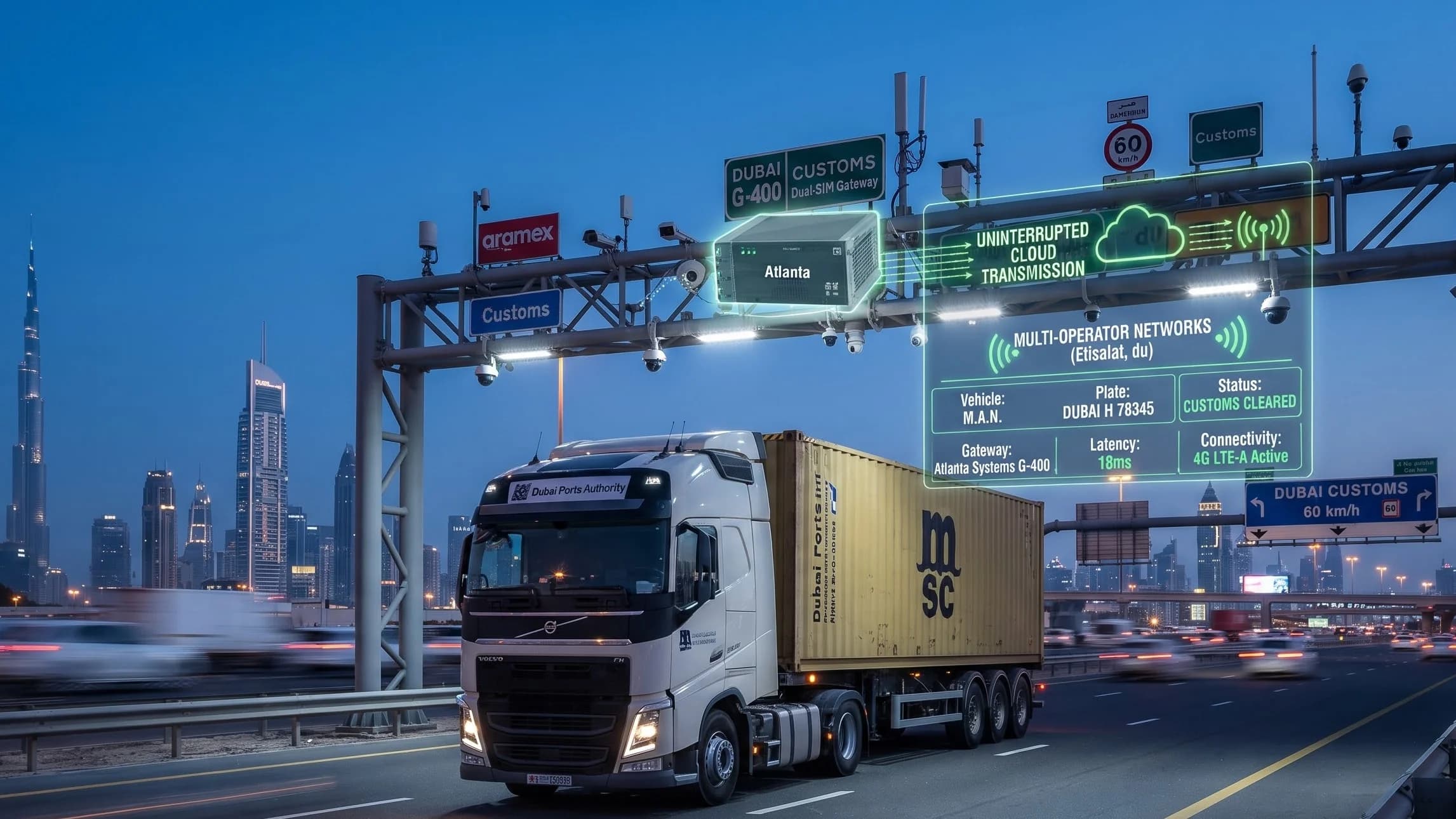
Smart Gateways by Atlanta Systems Powering Cold Chain Visibility Between Jebel Ali and Abu Dhabi

Table of Contents
- The GCC Cold Chain Challenge: Transit Realities on the E11 Corridor
- Hardware Architecture: GWC-100 Smart IoT Cold Chain Gateway
- System Architecture: Trailer Network and Cloud Telematics
- Technical Comparison: GWC-100 Gateway vs. Conventional Cab Trackers
- Field Implementation Case Study: JAFZA Food Distributor
- Conclusion & Next Steps for Fleet Operators
The high-speed transport corridor connecting Dubai’s Jebel Ali Free Zone (JAFZA)—the largest marine port and logistics hub in the Middle East—to Abu Dhabi’s industrial zones in Mussafah, KEZAD, and central retail distribution networks represents one of the most critical perishable supply routes in the GCC. Traversing the E11 Sheikh Zayed Road, refrigerated transport fleets move fresh produce, dairy, frozen proteins, and biopharmaceuticals under extreme ambient conditions, where summer temperatures regularly exceed 50°C (122°F) with intense humidity. Under the UAE Ministry of Climate Change and Environment (MOCCAE) and Abu Dhabi Agriculture and Food Safety Authority (ADAFSA) mandates, commercial food transporters must maintain uninterrupted, verifiable cold-chain integrity. A single refrigeration failure or unauthorized door opening during this 120-kilometer high-speed corridor can destroy valuable cargo within thirty minutes. Atlanta Systems addresses these operational demands with the GWC-100 smart IoT cold-chain gateway. Acting as a central multi-radio telematics hub, the GWC-100 connects wireless TSI-100 environmental probes, IBK-10 BLE beacons, and vehicle refrigeration controllers, delivering real-time cloud visibility and automated excursion alerts across the Emirates.
The GCC Cold Chain Challenge: Transit Realities on the E11 Corridor
Transporting perishables across the Jebel Ali to Abu Dhabi freight corridor presents unique operating challenges:
- Extreme Thermal Shock at Dock Transitions: When reefer rear doors are opened at loading docks in JAFZA, ambient air exceeding 48°C enters the refrigerated trailer, causing rapid condensation and thermal spikes that take up to 20 minutes to stabilize once transit begins.
- Corridor Speed and Cellular Handovers: Commercial delivery trucks travel at sustained speeds of 80 to 90 km/h along the multi-lane E11 highway. Gateways must execute fast, reliable cellular handovers across Dubai and Abu Dhabi telecom networks (e& and du) without packet loss.
- Multi-Drop Urban Deliveries: Haulers delivering to multiple supermarket hubs in Abu Dhabi execute frequent door openings, requiring instantaneous door-status detection to prevent refrigeration cooling loss.
Relying on standalone cab-mounted GPS trackers with long wire runs into the refrigerated trailer often results in wire corrosion and communication failures. A dedicated, trailer-mounted smart gateway provides a far more robust, reliable telematics architecture.
Hardware Architecture: GWC-100 Smart IoT Cold Chain Gateway
The GWC-100 is an industrial-grade, multi-radio edge telematics gateway engineered specifically for refrigerated trailers, intermodal containers, and cold-storage facilities:
```
```
1. Multi-Sensor Wireless Aggregation Core
The GWC-100 acts as an intelligent edge aggregator. Rather than relying on fragile physical wiring through insulated trailer panels, the gateway communicates wirelessly via BLE 5.0 with up to 32 distributed nodes, including TSI-100 temperature/humidity probes, IBK-10 cargo beacons, and wireless magnetic door-contact sensors.
2. High-Capacity Autonomous Battery Backup
In intermodal staging yards at Jebel Ali Port, trailers are often decoupled from tractors for hours or days without external battery power. The GWC-100 integrates an internal 5200 mAh rechargeable lithium-ion battery pack, sustaining autonomous environmental monitoring, door-open detection, and periodic GPS tracking for up to 30 days without external chassis power.
System Architecture: Trailer Network and Cloud Telematics
Deploying the GWC-100 creates an integrated, self-healing telemetry network across the entire refrigerated trailer:
```
```
- Exterior Bulkhead Mounting: The GWC-100 is mounted directly to the trailer's front exterior wall adjacent to the refrigeration unit. Its IP67 enclosure withstands heavy road spray, intense UV radiation, and automated truck wash systems.
- Reefer Controller Interface: In addition to its BLE wireless sensor network, the GWC-100 features an RS485 serial port that connects directly to OEM refrigeration unit controllers (such as Thermo King and Carrier Transicold). This enables remote extraction of engine operating hours, active alarm codes, setpoint temperatures, and operational modes (continuous vs. start-stop).
- Instant Door-Opening Correlation: When an exterior door is opened, the wireless magnetic sensor notifies the GWC-100 in milliseconds. The gateway correlates the door opening with temperature rises, preventing false alerts during authorized unloading while alerting supervisors if doors remain open beyond configured time limits.
Technical Comparison: GWC-100 Gateway vs. Conventional Cab Trackers
| Feature / Metric | Atlanta Systems GWC-100 Gateway | Standard Cab GPS Tracker |
|---|---|---|
| Mounting Location | Directly on Trailer Exterior Bulkhead | Inside Truck Cab (Under Dashboard) |
| Trailer Disconnection Tracking | Fully Autonomous (Internal 5200mAh Battery) | Goes offline when trailer uncoupled |
| Sensor Connectivity | Wireless BLE 5.0 (Up to 32 Probes) | Requires running wires through cab |
| Reefer Controller Integration | RS485 Integration with Major OEMs | No direct reefer link |
| Environmental Protection | IP67 Submersion & UV Proof Enclosure | Unsealed Plastic (IP40 / IP54) |
| Memory Buffer | 64,000 Records (Zero Data Loss) | 2,000 to 5,000 Basic Records |
Field Implementation Case Study: JAFZA Food Distributor
A leading UAE food distributor operating 65 multi-temperature distribution trailers between Jebel Ali cold stores and retail hypermarkets in Abu Dhabi and Al Ain deployed the GWC-100 system:
- Cargo Loss Elimination: Spoilage claims caused by undetected reefer engine shutdowns or improper temperature settings dropped by 92% in the first summer of operation.
- Rapid Excursion Response: An alert generated when a trailer door was accidentally left open at an Abu Dhabi unloading dock allowed supervisors to intervene before temperatures exceeded critical thresholds, protecting a $120,000 shipment of imported dairy.
- Regulatory Compliance: Automated digital temperature reports streamlined inspection approvals by municipal food safety authorities at Abu Dhabi entry checkpoints.
Conclusion & Next Steps for Fleet Operators
Maintaining an unbroken cold chain along demanding GCC transport corridors like Jebel Ali to Abu Dhabi requires purpose-built telematics hardware engineered to withstand extreme environmental heat. Atlanta Systems' GWC-100 smart IoT gateway, paired with TSI-100 environmental probes and IBK-10 beacons, provides commercial fleet operators with the reliability, precision, and compliance verification needed to protect sensitive perishable cargo.
To schedule a technical consultation, request engineering drawings, or evaluate a demonstration kit, contact Atlanta Systems' Middle East engineering team at sn@atlantasys.com or visit www.atlantasys.com.
Co-Founder at Atlanta Systems Pvt. Ltd., spearheading large-scale global telematics supply chains, commercial fleet compliance deployments, and OEM electronics manufacturing partnerships.